The Crisis Whisperer: A Profile of Adam Tooze
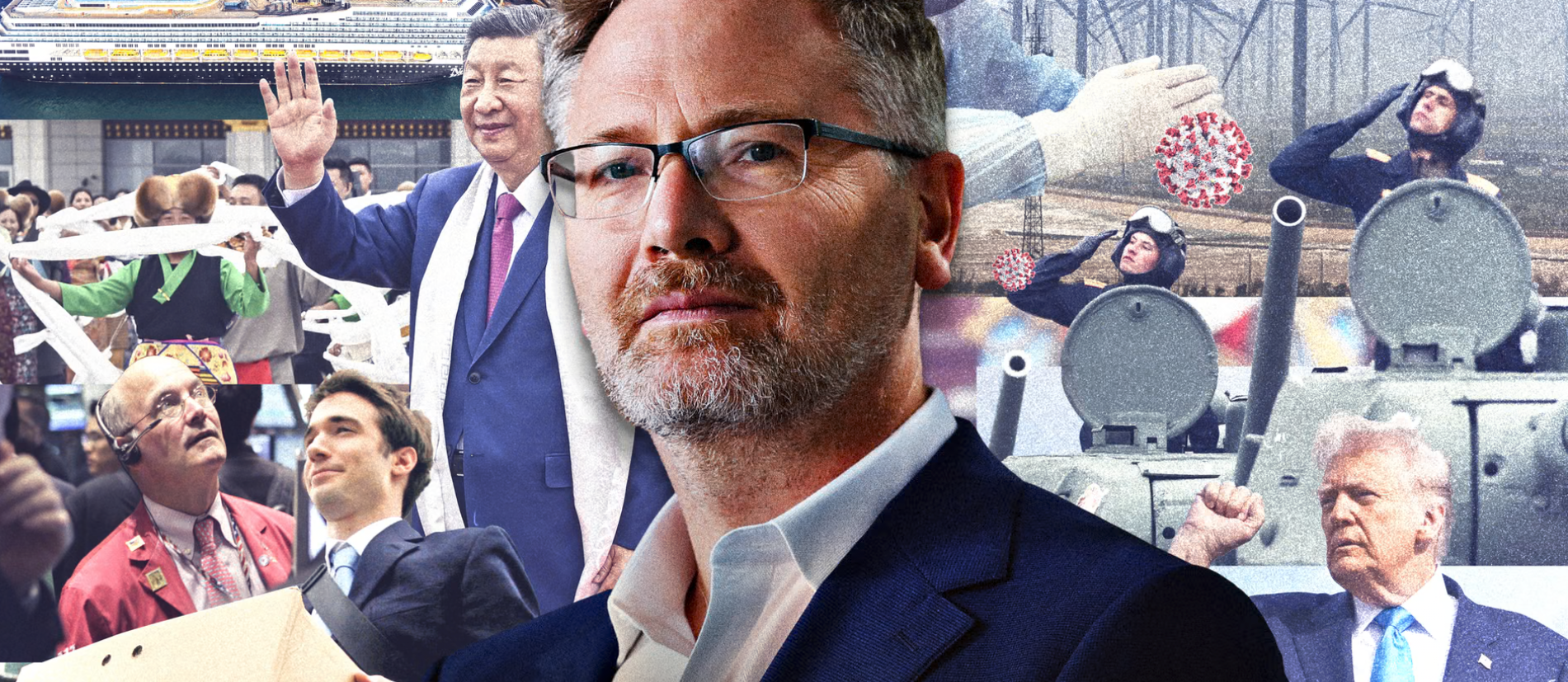
Also today I have a new feature up in The Guardian Long Read: a profile of Adam Tooze, an economic historian described by his editor at the Financial Times as "a sort of platonic ideal of the universal intellectual."
You can thank my marvelous editor, David Wolf, for sparing you the unmanageable mid-five-figure word counts of my early drafts, even if it means you won't be reading about Tooze's affinity for throwing parties or his ability to write Chartbook essays just a few hours after the last of his guests have gone home. (“I picture him wearing an apron, and taking your coat, and offering you a glass of sparkling wine as you enter. He loves entertaining. You go to his house and he’s purchased a lot of cheese and a lot of nice little fishes,” one friend told me. "We will all leave at three o'clock in the morning. And I'll get a Chartbook email at seven the next day. And I'm like, ‘Adam, when did you do that?’ And he’ll say, ‘This morning.’”)
But you can still read about Tooze's youth in West Germany, which, among other things, saw this future historian of Nazi economics eating dinner on Albert Speer's table:
West Germany was reckoning with its Nazi past, and Tooze says that the ambient political atmosphere weighed heavily on his youth. “I spent a lot of time identifying with the perpetrator, asking myself what kind of a Heydrich I would have been.” At that time in that place, the question was far from abstract. “I went to school with Albert Speer’s grandson. We were the big science dignitaries that arrived in the little village outside Heidelberg where the Speers lived, and they made us welcome. My parents were invited to dinner, and the Speers said, ‘Do you need some furniture? Here’s a table.’ Literally the whole time we were in Germany we were eating off Albert Speer’s table.”
You can also read about his beef with the Biden Administration…
“These were a group of entirely self-satisfied American liberal elites who were enacting a morality tale in which Sheen and The West Wing and that whole highly sentimental vision of power and politics is a central device. She says this, I think, meaning to sound tough, like, ‘I’m the warrior. Who are you? You’re just some desktop guy.’ Which just shows how little she understands what I’m saying, which is: ‘You people are a bunch of sentimental schmucks who don’t understand that you lost. If you had any self-respect, you would not be on any podium again, ever, sounding off about anything. Because comrades, if we were in the 30s, I would have taken you out and shot you. You fail like this, you don’t get to come back and show off your wounds.’”
…his surprising embrace of certain aspects of a devastating critique by Perry Anderson in the New Left Review…
Tooze said that Anderson’s attack helped him clarify his own principles and practices. Anderson used the phrase “in medias res” as a jab at Tooze’s neglect, as he saw it, of the deep political and economic forces that shaped his narratives. Yet Tooze has come to embrace in medias res both as “a very succinct summation of the challenge that I’m particularly interested in” and as a simple but profound description of the basic human situation. In his view, there is no escaping the middle of things: every one of us is born, lives and dies in a rushing flow of events that precedes us and will outlast us.
…and Tooze's conviction that far too few people understand the scale of what's happening in China right now, especially when it comes to the green-energy transition:
At the New School, Tooze made a similar argument. He cited another favourite statistic: whereas the US’s total installed solar capacity is on the order of 250GW, “China currently has the capacity to churn out 1,200GW of photovoltaic panels in a single year.” In those Chinese solar panels Tooze sees a climate-era analogue to the Soviet T-34 tanks. At development and climate meetings, he said, you can go a long time without hearing anyone acknowledge that China matters vastly more to the climate-change story than anything happening anywhere else, very much including the US.
Check out the rest of the piece at The Guardian.
