July 5, 2026
I Was Wrong about AI
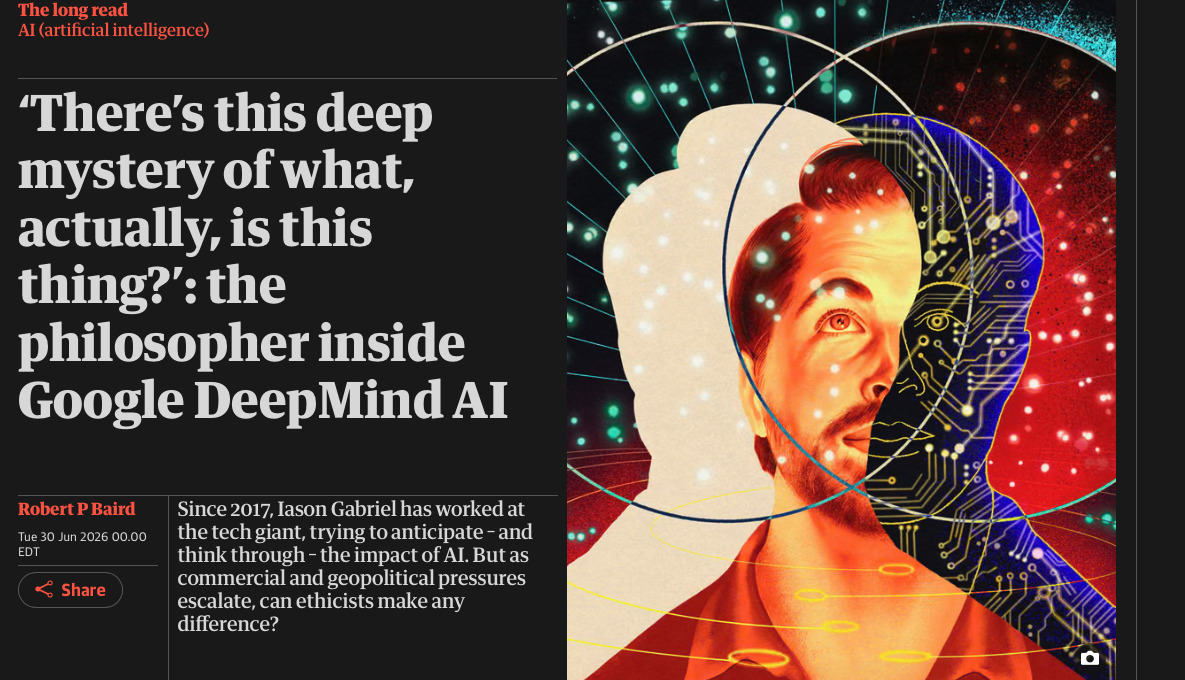
TLDR: I profiled Iason Gabriel, an in-house ethicist and philosopher at Google DeepMind, for The Guardian Long Read. Keep reading if your first question on hearing that is: “But Bobby, why?”
Last fall, I started keeping a list.
At the time, I was feeling inundated—oppressed wouldn’t be too strong a word—by the hype around artificial intelligence. In the space of a few short years, AI had gone from being a niche hobby funded by technofuturist billionaires to being, well, everywhere. On TV and on the internet, in the mouths of CEOs and celebrities, all over the business, culture, and news pages, AI was suddenly as inescapable as the social-media musings of one Donald J. Trump.
I didn’t get it. Not only that: I was pretty certain they didn’t get it, either, by which I meant, roughly, everyone. I knew enough to know that “artificial intelligence” was a clumsy category that included many different technologies. I knew as well that some of those technologies—autocomplete, email-spam detection, Google Translate—had been so successful that we no longer thought of them as AI.
But I also knew that this new wave of AI excitement, based on the deployment of so-called large language models, had all the makings of a classic Silicon Valley hype cycle. The people promising that LLMs were going to be the Next Big Thing sounded exactly like the people who had promised us that NFTs and the metaverse were going to the Next Big Thing, and the fact that it was often the same people doing all that promising ratified my sense that AI was at best a passing fad. At worst and more likely, it was a scam.
I didn’t think this was unfair. When OpenAI released ChatGPT, in November of 2022, I was one of the millions who duly marveled at its ability to instantly generate, say, a sonnet in rhyming Cockney about the wonders of black licorice. This was dazzling for a few hours, and neat for a few days. Pretty quickly, however, the novelty gave way to the sense that it was little more than a digital parlor trick. The robot couldn’t count! It made up facts! It burned gigawatts of energy and depended, for its training, on real writing that had been pirated from real people. And for what? To generate slop in a tone so relentlessly bland and obsequious that made you want to feed your laptop, and maybe your brain, into the nearest wood chipper? No thanks.
Late last summer, however, people I knew, people I trust, people whose writing and thinking and work habits I respected without caveat, began to let slip that they were finding ways to productively use AI. No, no, they insisted, when they saw my scowling horror. It’s good now, really. Not for everything, they said, maybe not for most things, but for some tasks—computer coding, language learning, even some kinds of research—they told me that AI had become nearly indispensable. This enthusiasm dismayed me at first, and then it puzzled me. Finally it intrigued me.
This how my list began. Figuring I should see for myself, I decided I’d give AI a real shot. I would keep track of what I anticipated would be the very short list of things where it proved actually useful. On the advice of my friends, I paid for a monthly subscription to Claude, an LLM made by Anthropic, and started poking around to see what it could do.
You can guess what happened next: the tentative experiments, the adventures in vibecoding, the growing recognition that I’d been wrong, badly wrong, to assume the AI hype was only hype. Within the space of a few months, what had started as a grudging test became an eager experiment. I did all the things that middle-aged dads are required to do on first contact with a functioning LLM. I built an app that tracked our family’s meal plans, calendars, and grocery lists. I made a word game that worked well enough that my wife and son played it with me at least three times each. I set up an email digest that sent me the weather, my calendar events, the news, and a bit of poetry each morning, the latest in a long line of attempts to help me stay engaged with the world without losing endless hours to doomscrolling. I even rigged up an LED panel to display basketball scores on command.
By any reckoning, much of this was mere tinkering. But it was not only that. For years, for decades really, I have longed for a computer program that would help me at a crucial stage of my writing projects. I don’t mean the writing proper: no part of me wants a computer to do my writing for me, a verb that in my mind encompasses everything from brainstorming to outlining to drafting to revising to proofreading. Still, I have always struggled with how best to wrangle and organize the huge heap of transcripts, notes, and highlights that I accumulate in the course of my research. I have tried various off-the-rack options, and have even come to appreciate some of them (hello, Scrivener!) but I never found anything that did exactly what I wanted it to do. Nothing, that is, until Claude helped me build the app I wanted from the ground up.
This was, I can’t lie, exciting. I like tinkering. (Not for nothing did I study mechanical engineering in college.) But it was also less comforting than it might at first sound. Certainly I hadn’t been happy at the thought that AI was a fad or a scam, especially one that seemed likely to crash the global economy and/or push the global climate up another deadly degree. Still, as long as I was sure that AI was basically ineffective, I could at least take a kind of solace from the prospect that sooner or later the madness would pass. Great gobs of money might be lost, taking companies and jobs down with them. The datacenters might go as uselessly dark as an old coal stove. The Silicon Valley hype train might find itself, like the traveling hucksters of old, forced to find a new class of snake oil. But at least the world would eventually come to its senses.
My belated reevaluation shook me out of my complacency. If AI was the real deal, then a whole bunch of questions I was able to dismiss before seemed suddenly urgent. It was with those questions in mind that I decided to profile Iason Gabriel, a philosopher and ethicist at Google DeepMind. Gabriel was, as best he or I can figure, the first philosopher to be hired as a philosopher at a frontier AI lab. He brought to the field of AI ethics a perspective that differed in interesting and productive ways from the dominant threads of debate, and anticipated many of the key challenges that would confront AI when it became a technology used by billions.
My piece about Gabriel was published by the Guardian Long Read earlier this week. You can—I hope you will—read it here.